
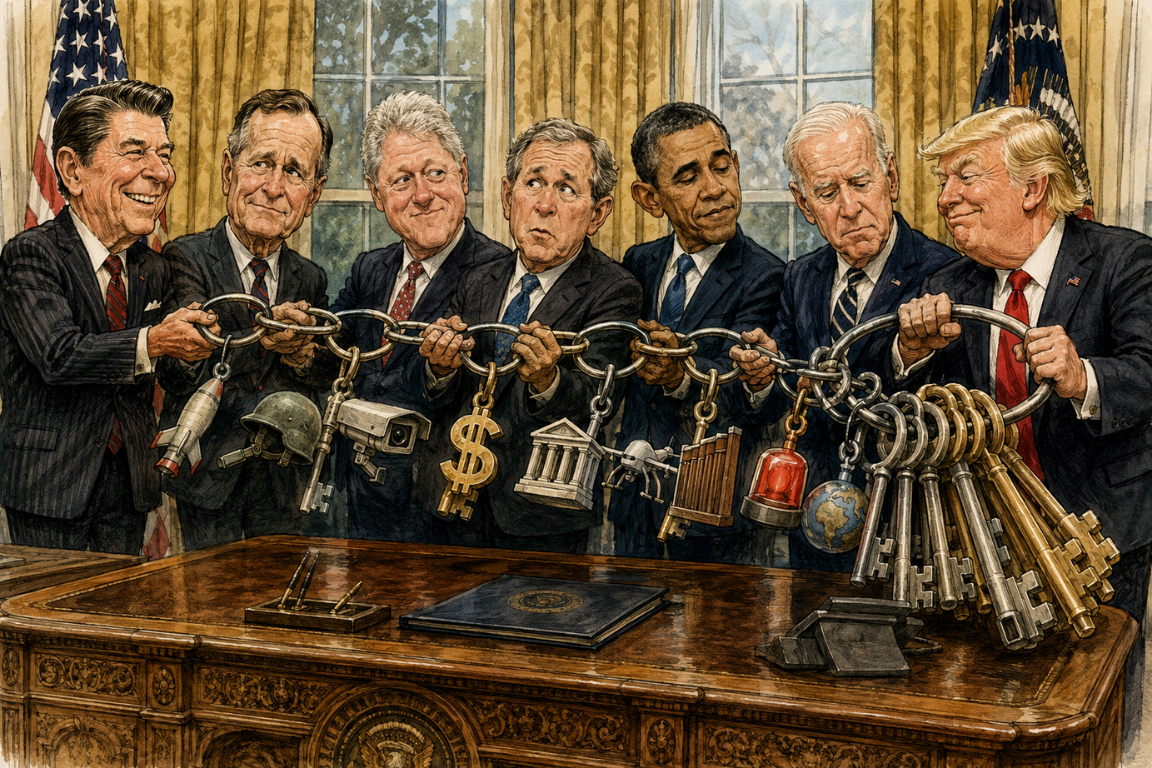
This isn’t about Democrats and Republicans. That’s the problem.
I have grievances with every president. Some lists are considerably longer than others.
Some grievances involve policies I believe were cruel. Some involve wars I believe should never have been fought. Some involve people the government failed to protect. Some involve economic decisions that shifted power upward while leaving ordinary Americans increasingly insecure. And some involve presidents using powers I do not believe any president should possess.
But after looking at these administrations together, I realized my largest grievance is not with any one of them. It is with what they inherited from one another.
American presidential power did not expand simply because one president woke up one morning and decided to become a king. Congress delegates authority. Presidents interpret it, stretch it, and set precedents around it. Courts decide how far some of those powers reach and sometimes hand over more than the president asked for. Federal agencies build institutions around them. Emergencies make extraordinary measures seem necessary. Then the emergency passes, a new president arrives, and much of the emergency machinery remains.
Eventually, what once looked extraordinary starts to look normal.
Ronald Reagan did not create the presidency Donald Trump occupies today. Neither did George H. W. Bush, Bill Clinton, George W. Bush, Barack Obama, Joe Biden, or Trump himself. But, they all helped shape it; not equally, not for the same reasons, not with the same intentions, and certainly not with the same consequences.
That distinction matters. The parties are not the same. The presidents are not the same. Elections matter enormously precisely because presidential power matters enormously.
But that leaves me with a question more important than which party I want controlling the White House: Why have we built a presidency that requires us to trust the person sitting in it this much?
A thread runs through every section of what follows: American policy toward Israel and Palestine. It is the clearest tracer dye I know of for the argument I am making. Much of that relationship is conducted through executive tools such as recognitions, memoranda of understanding, UN votes, envoys, and aid decisions. Presidents can shift important parts of the policy without passing a new law. Watching what changes, and what does not, when the presidency changes hands tells us a great deal about the difference between political change and structural continuity.
Ronald Reagan: Changing the Rules
Ronald Reagan did not invent inequality, union busting, American interventionism, conservative Christianity, or the War on Drugs. What his presidency did was help change what Americans considered politically normal.
In August 1981, roughly 13,000 members of the air traffic controllers’ union walked off the job. Reagan ordered them back to work. The strike was illegal under federal law. A 1955 statute barred strikes by federal employees, and the Supreme Court had upheld the ban a decade earlier. When most refused to return, the government fired 11,345 of them and barred them from federal service for life.
That distinction matters. Reagan did not illegally destroy an innocent union exercising an unquestioned right to strike. But PATCO became something larger than a labor dispute. It became a symbol of a new relationship between organized labor, employers, and government. Private employers noticed too.
Union membership had already been declining since the mid-1950s, and no single president caused the collapse of organized labor. But during the Reagan era, American politics moved further away from the mid-century assumption that organized labor should function as a major counterweight to corporate power.
Then came Reaganomics. The top individual marginal income-tax rate fell drastically under the 1981 tax law, and much more after the 1986 tax overhaul. Reagan also signed tax increases when deficits became too large of a problem in 1982, 1983, 1984, and 1987, so the story is not eight uninterrupted years of tax cuts for the rich.
The deeper change was philosophical. Lower corporate and high-income taxes, deregulation, skepticism toward federal social programs, hostility toward organized labor, and confidence in markets became increasingly central assumptions of American economic politics.
Reagan left office in 1989. Reaganism did not.
His administration also intensified the War on Drugs. The 1986 Anti-Drug Abuse Act created mandatory sentencing rules under which five grams of crack cocaine and 500 grams of powder cocaine triggered the same five-year mandatory minimum. A hundred-to-one ratio. The racial consequences were enormous. Future presidents would modify that system, but first they would inherit it.
Abroad, Reagan supported the Contra war against Nicaragua’s Sandinista government even as Congress passed a series of amendments restricting American support. Iran-Contra ultimately exposed something larger than one scandal. It exposed a constitutional temptation that would reappear repeatedly: what happens when a president believes a foreign-policy objective is too important to let Congress stop him?
Reagan also helped consolidate the alliance between the Republican Party and conservative evangelical Christianity. He did not create the Religious Right, but he embraced it, spoke its language, and helped make conservative Christianity an increasingly powerful component of Republican electoral politics. That coalition would evolve for decades before finding perhaps its most consequential political instrument in a man whose personal life looked almost nothing like the moral ideal the movement had once claimed to demand.
Then there is AIDS.
The first cases were reported in 1981. The epidemic devastated communities already subjected to enormous stigma, particularly gay men. Federal spending did rise substantially, from roughly $8 million in fiscal 1982 to about $1.6 billion in fiscal 1988, with cumulative spending across Reagan’s presidency exceeding $5.7 billion. So I am not going to say Reagan “did nothing.”
My grievance is more specific. Congress repeatedly appropriated more for AIDS than the administration requested, and for years the president did not use the extraordinary public power of his office with anything approaching the urgency the epidemic warranted. He did not deliver a major speech on AIDS until 1987, six years into the crisis.
Presidential power is not only the ability to deploy troops or issue executive orders. A president also has the power to tell a country that certain people matter, that their lives matter, and that the country must pay attention. Reagan waited far too long to use it.
George H. W. Bush: Preserving the Revolution
George H. W. Bush inherited Reagan’s America. He did not simply reproduce it. He famously broke with conservative orthodoxy and agreed to tax increases when fiscal reality demanded them, at considerable political cost. But much of the larger structure remained.
Bush intensified and institutionalized the War on Drugs. His administration expanded federal support for state and local law enforcement, prisons, prosecutors, and the machinery of criminal punishment. The punitive framework Reagan had accelerated became more deeply embedded in federal policy.
Then there was Panama. Manuel Noriega was an authoritarian ruler deeply entangled with drug trafficking who had nullified the May 1989 election after the opposition won it by roughly three to one. That context matters. But so does what the United States did. Bush committed some 26,000 troops to Operation Just Cause, invaded another sovereign country, removed its de facto ruler, captured him, and brought him to Florida to stand trial.
Soon afterward, Iraq invaded Kuwait. The Gulf War had a far stronger international and legal foundation than the Iraq invasion twelve years later. A broad coalition expelled Iraqi forces from Kuwait under United Nations authority, and Bush went to Congress for authorization. Those distinctions matter too.
But the post-Cold War message was becoming clear. The United States possessed military power on a scale no rival could match and increasingly saw itself as the central enforcer of the international order.
The war ended, but the confrontation with Iraq did not. Sanctions remained. Weapons inspections continued. Iraqi civilians suffered enormously under an economy devastated by war, sanctions, and Saddam Hussein’s own brutal and obstructive government. Clinton would inherit that problem, and George W. Bush would inherit it after him.
Then, on Christmas Eve 1992, weeks before leaving office, Bush demonstrated another extraordinary presidential power. He pardoned six people connected to the Iran-Contra investigation: former Defense Secretary Caspar Weinberger, whose trial was weeks away; former National Security Adviser Robert McFarlane; former Assistant Secretary of State Elliott Abrams; and three CIA officials.
Independent Counsel Lawrence Walsh responded furiously that the six-year Iran-Contra cover-up “has now been completed.” That was Walsh’s accusation, not a judicial finding that Bush himself committed a crime.
But the constitutional problem remains. A president who had served as vice president throughout the events under investigation possessed the unquestioned authority to extinguish criminal jeopardy for officials caught up in it, including one whose notes were expected to bear on the vice president’s own role.
The pardon power would become relevant again in later presidencies, particularly when presidents used it for political allies, associates, and people connected to investigations touching their own administrations.
Bill Clinton: When Reaganism Crossed the Aisle
If the Reagan Revolution belonged only to Ronald Reagan and the Republican Party, Bill Clinton should have ended it.
He didn’t.
That does not make Clinton exactly the same as Reagan. Clinton expanded the Earned Income Tax Credit, signed the Family and Medical Leave Act, raised taxes on higher earners, appointed Ruth Bader Ginsburg and Stephen Breyer to the Supreme Court, and attempted major health-care reform. The differences were real and significant.
But something more consequential happened during his presidency. Large portions of the post-Reagan political order became bipartisan.
Clinton championed NAFTA, an agreement negotiated under George H. W. Bush, embracing a model of globalization that increased the ability of capital and production to move across borders while American workers remained considerably less mobile. He signed welfare reform in 1996, replacing Aid to Families with Dependent Children with the more restrictive, work-oriented, and time-limited TANF system.
He signed the 1994 crime bill, which included the Violence Against Women Act and crime-prevention funding but also poured federal money into police hiring and prison construction at the height of America’s punitive era.
Then came financial deregulation. Clinton signed Gramm-Leach-Bliley in 1999, repealing sections of Glass-Steagall that had kept commercial banks from affiliating with securities firms. No, that one law did not single-handedly cause the 2008 financial crisis. History is rarely that tidy, and other parts of Glass-Steagall survived.
If anything, the more consequential deregulation came a year later in the Commodity Futures Modernization Act of 2000, which exempted over-the-counter derivatives from meaningful regulation, including instruments that would sit at the center of the crash. That is worth noticing because it means the road to 2008 ran through Congress at least as much as through any president.
This is why Clinton matters so much to this story. Reagan changed American political assumptions. Clinton proved many of them could survive a Democratic presidency.
Meanwhile, Iraq remained under sanctions and recurring American military pressure. The United States enforced no-fly zones. Clinton signed the Iraq Liberation Act of 1998, which declared that it should be American policy to seek Saddam Hussein’s removal and authorized up to $97 million in aid to Iraqi opposition groups while pointedly declining to authorize the use of American combat forces. Then he ordered the four-day bombing campaign of Operation Desert Fox.
George W. Bush did not inherit a peaceful, normal relationship with Iraq. He inherited a country already under sanctions, weapons inspections, military containment, and a declared American preference for regime change.
That does not make the 2003 invasion inevitable. Bush made that choice. But history did not begin in March 2003.
There is one more Clinton entry that belongs here, and it is one often left out of accounts sympathetic to him.
In 1999, Clinton took the United States to war in Kosovo through a seventy-eight-day NATO air campaign without congressional authorization. The House actually voted down a resolution supporting the air war. The campaign ran well past the sixty-day clock in the War Powers Resolution, and the administration argued its way around it.
I think the humanitarian case for intervening in Kosovo was strong.
That is exactly the point.
The most dangerous precedents are rarely set by the worst causes. They are often set by good causes. And then they stay in place.
Clinton also signed the Defense of Marriage Act. It is worth remembering because politicians are products of their political moments, and positions that later generations recognize as discriminatory can be comfortably mainstream while the discrimination is occurring. Democratic presidents are not automatically progressive merely because the Republican alternative may be worse.
Then there was Rwanda.
In roughly one hundred days in 1994, around 800,000 people were slaughtered. Estimates vary widely, with serious scholarship ranging from about 500,000 to more than a million, but the scale is not in dispute.
The United States did not cause the genocide, and Clinton could not have ended it by decree. But the international community failed catastrophically, the United States was part of that failure, and American officials worked to avoid the word “genocide” precisely because using it might have created an obligation to act. Clinton apologized in Kigali in 1998.
Sometimes my grievance with presidents is that they use too much power. Rwanda is the opposite. Sometimes enormously powerful governments watch atrocities unfold and decide intervention is too difficult, too risky, or insufficiently important.
Power unused is still a choice.
George W. Bush: Building the Machinery
Then September 11 happened.
Nearly 3,000 people were murdered in a coordinated attack in the United States. Any honest evaluation of what followed has to begin there. The fear was real. The harm was real.
Congress responded within a week by passing the Authorization for Use of Military Force. Sixty words of operative text authorized the president to use “all necessary and appropriate force” against the nations, organizations, and people he determined had planned, authorized, committed, aided, or harbored those responsible for the September 11 attacks.
A quarter century later, that authorization is still on the books.
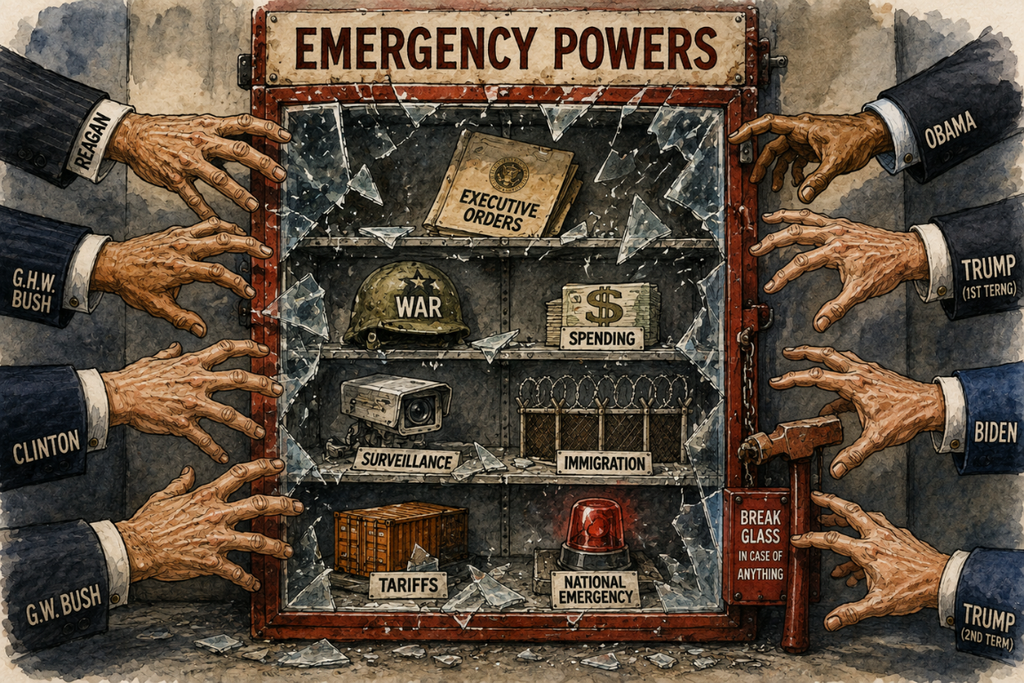
A Congress responding to an emergency in September 2001 created an authority that would be inherited by Bush, Obama, Trump, Biden, and Trump again. The emergency changed. The authority remained.
Bush invaded Afghanistan with broad domestic and international support. Then came Iraq, which Congress authorized separately in 2002. The administration presented intelligence about weapons of mass destruction with far greater certainty than the underlying evidence warranted.
The Senate Intelligence Committee’s 2004 report found that the intelligence community had suffered from “group think.” The Robb-Silberman Commission the following year blamed poor collection, weak tradecraft, and an analytical process driven by assumption rather than evidence.
Notably, both investigations concluded analysts had not been pressured to change their conclusions. You do not need to claim Bush secretly knew every WMD allegation was false. The documented failure is serious enough: uncertain and deeply flawed intelligence became political certainty, and a war followed.
The consequences reshaped the Middle East. But the Bush legacy goes considerably beyond Iraq.
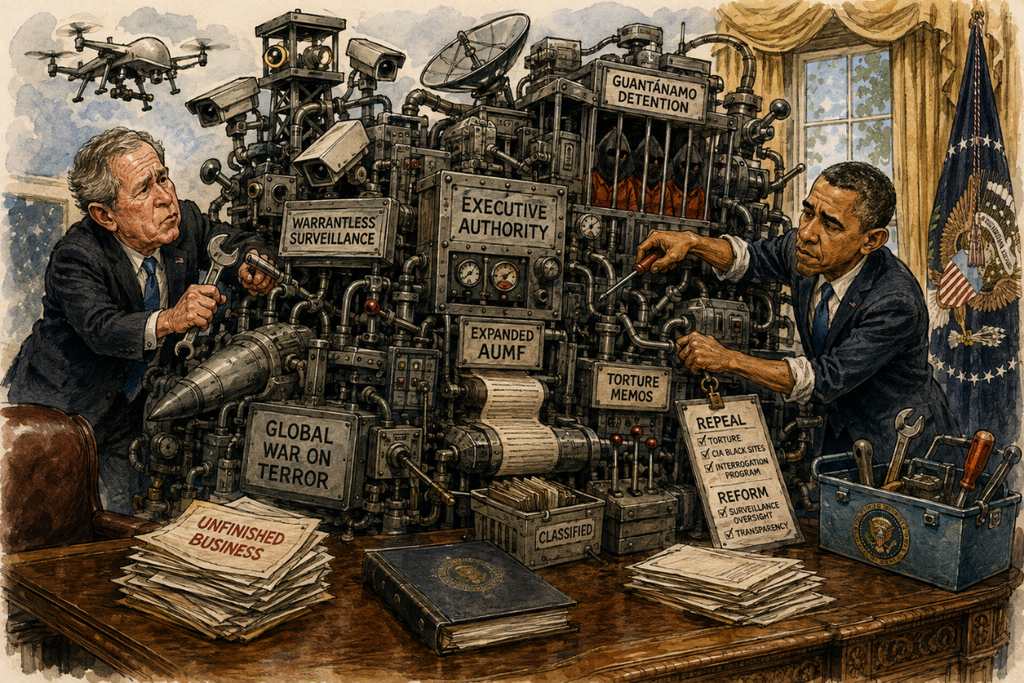
The War on Terror expanded surveillance. The administration authorized warrantless electronic surveillance outside the ordinary FISA process, a program conducted in secret for years. When it was exposed, Congress responded not by shutting it down but by amending surveillance law to accommodate much of it, first in 2007 and then through the FISA Amendments Act of 2008.
That is one of the most important ways extraordinary power becomes permanent. First, the government says it must do something because there is an emergency. Then the controversy becomes a fight about oversight. Eventually the argument shifts from whether the government should possess the capability at all, to what rules should govern its use.
Bush also created the detention system at Guantánamo Bay and claimed sweeping authority over “enemy combatants.” His Office of Legal Counsel produced memoranda that defined torture narrowly enough to authorize coercive interrogation techniques the United States had long claimed to reject. It is a reminder that some of the most consequential expansions of presidential power happen in legal opinions almost nobody reads.
Abu Ghraib showed the human consequences.
Bush also made aggressive use of a quieter tool: the presidential signing statement. His administration challenged well over a thousand statutory provisions in these documents, asserting the authority to decline to enforce parts of laws he had just signed, including, most famously, the McCain torture ban.
It is executive lawmaking by annotation, and every president since has kept the practice.
But institutions did push back. The Supreme Court repeatedly rejected portions of the detention system in Rasul, Hamdi, Hamdan, and Boumediene. Congress participated in shaping it. Journalists, lawyers, whistleblowers, civil servants, and military officers exposed abuses.
That matters because the presidency is powerful, but it is not the entire government. Resistance is possible. It is just slower than expansion.
Then came Hurricane Katrina. The failures belonged to federal, state, and local government, not Bush alone. But Americans watched fellow citizens stranded without adequate food, water, medical care, or transportation while governmental systems stumbled.
It exposed the other side of state power. What good is an enormously powerful government if it cannot competently protect people when they desperately need it?
And then there is Israel and Palestine, where Bush did something genuinely new.
In a Rose Garden speech in June 2002, he declared that when Palestinians had new leadership, institutions, and security arrangements, the United States would support the creation of a Palestinian state. His administration backed the Road Map for Peace and formally envisioned two states.
It is often called the first presidential endorsement of Palestinian statehood, and as a standing statement of American policy, it essentially was, although Clinton’s parameters of December 2000 had already sketched a sovereign Palestinian state as a negotiating proposal in his final weeks.
Bush deserves real credit for making it doctrine rather than a departing offer.
But Palestinian statehood was conditioned on extensive reforms, security obligations, and political changes, while Israel already possessed sovereignty, overwhelming military superiority, and extensive American support.
Then, in 2007, Bush’s administration negotiated a ten-year memorandum of understanding committing the United States to roughly $30 billion in military aid to Israel, covering fiscal years 2009 through 2018.
That agreement was designed to outlast him.
It did.
Barack Obama: Reforming the Machinery Without Dismantling It
Barack Obama inherited two wars, Guantánamo, the War on Terror, an enormous surveillance state, and the worst financial crisis since the Great Depression.
He genuinely reversed parts of Bush’s legacy. On January 22, 2009, his second full day in office, Obama ordered Guantánamo closed within a year. He prohibited the CIA interrogation practices associated with the Bush era and ordered CIA detention facilities shuttered.
Those were meaningful changes, and they demonstrate something important: presidents sometimes do reject practices and surrender powers they inherit.
But Guantánamo did not close. Congress bears significant responsibility, having imposed successive restrictions on detainee transfers. Again, the president is not the government. Yet the detention system survived Obama, and it has now survived four presidents.
So did the 2001 AUMF.
Obama’s administration eventually argued that an authorization passed in response to September 11 could support military operations against ISIS, an organization that did not exist on September 11 and had publicly broken with al-Qaeda in early 2014. A wartime authorization written for one enemy in one historical moment had become part of the legal foundation for fighting a different enemy in a different country thirteen years later.
Obama also made targeted killing by drone a central counterterrorism tool. That included the September 2011 killing of Anwar al-Awlaki, an American citizen whom the government accused of serving as an operational leader of al-Qaeda in the Arabian Peninsula.
Al-Awlaki was not merely a political critic. But the constitutional question remains extraordinary: under what circumstances may the executive branch determine on its own that an American citizen abroad has joined the enemy and kill him without charge or trial?
Then came Libya.
Unlike Iraq, the 2011 intervention had UN Security Council authorization and significant international support, aimed initially at protecting civilians. Distinctions matter. But Obama initiated sustained military operations without a new congressional authorization and, when the campaign passed the War Powers Resolution’s sixty-day limit, his lawyers argued that the air campaign did not amount to “hostilities” within the meaning of the statute.
Two Democratic presidents in twelve years had now taken the country to war in the Balkans and North Africa without asking Congress.
The practical presidential power to use force kept growing.
Obama inherited the surveillance state and reformed parts of it after Edward Snowden exposed its scale. The USA FREEDOM Act of 2015 ended the government’s bulk collection of Americans’ telephone metadata. That was real reform. It also, inevitably, put a democratic stamp of legitimacy on the larger architecture that remained.
Then there was the financial crisis. Obama helped prevent an economic catastrophe. Dodd-Frank imposed meaningful regulation, and the Consumer Financial Protection Bureau became a genuinely powerful institution for consumer protection.
Those accomplishments matter.
But millions of Americans lost homes, jobs, and savings while the largest financial institutions survived, and almost no senior Wall Street executive faced criminal prosecution. Whatever the legal reasons in individual cases, millions of Americans absorbed a political lesson: when ordinary people fail, they lose everything. When institutions become powerful enough, the government cannot afford to let them fail.
That resentment did not disappear. It flowed into Occupy Wall Street, the Tea Party, Bernie Sanders’s campaigns, and eventually Trump’s populist appeal. Those movements interpreted the same grievance in radically different ways, but the grievance was real.
Then there was Israel.
Obama’s relationship with Benjamin Netanyahu was often openly hostile. His administration increasingly condemned settlement expansion. In December 2016, in one of his final acts, the United States abstained rather than vetoing UN Security Council Resolution 2334, allowing a major international condemnation of Israeli settlements to pass.
Yet only three months earlier, Obama had signed a ten-year memorandum of understanding committing the United States to $38 billion in military assistance to Israel, the largest such package in American history, covering fiscal years 2019 through 2028.
Like all such agreements, it pledged rather than guaranteed. Congress still appropriates the money. But the political commitment was the point.
This is one of the clearest illustrations of the difference between policy disagreement and structural continuity. Obama could fight Netanyahu over settlements, pursue the Iran nuclear deal over his fierce objections, and let an anti-settlement resolution pass while simultaneously locking in the underlying military relationship for a decade.
Then Obama left office.
He left Donald Trump a presidency considerably more powerful than the one Ronald Reagan had inherited. Obama did not build that machine. He inherited it, dismantled pieces of it, repaired pieces of it, regulated pieces of it, and used pieces of it.
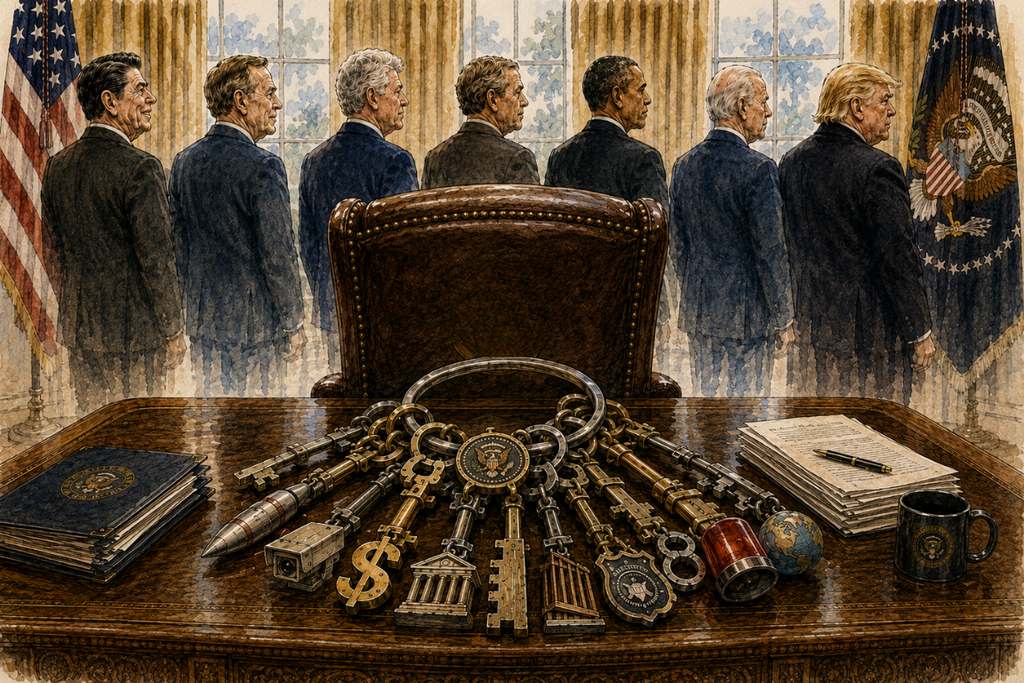
Then, on January 20, 2017, he handed over the keys.
Donald Trump: Someone You Don’t Trust Gets the Keys
Saying Trump inherited presidential power does not mean Trump was simply another version of Obama, Bush, or Clinton.
He wasn’t.
Presidents can inherit the same tool and use it very differently.
Immigration demonstrates this perfectly. Trump did not create ICE, the federal detention system, or the laws criminalizing improper entry. He inherited an enormous enforcement apparatus built through legislation and several administrations, Democratic and Republican.
Then his administration adopted “zero tolerance.” Parents were prosecuted for unlawful entry and separated from their children. The government proved disastrously unprepared to track and reunify those families. Investigators later found that the agencies involved lacked an adequate system for doing so, and years afterward some families still had not been reunited.
The machinery was inherited. The cruelty of that particular choice was not.
Trump also showed how emergency powers could collide with Congress’s constitutional power of the purse. Congress considered his border-wall funding request and appropriated a fraction of it. Trump declared a national emergency and moved to redirect military-construction and counter-drug funds toward the wall anyway.
He did not invent national-emergency statutes. Congress delegated those powers. Trump simply forced a question Congress should have confronted long before him: what happens when the emergency is whatever the president says it is?
Then Trump ordered the killing of Iranian General Qassem Soleimani in Baghdad. Soleimani was not an innocent bystander. He was among Iran’s most powerful military officials and was connected to operations that had killed Americans and destabilized the region.
But the president of the United States ordered the killing of a senior official of another sovereign government, on a third country’s soil, without Congress authorizing anything of the kind.
The deeper question is how the presidency accumulated enough unilateral military authority for one person to make a decision capable of bringing two countries to the edge of war.
The answer is not that Trump invented presidential war power. He inherited precedents from Reagan in Nicaragua, Bush in Panama, Clinton in Kosovo, and Obama in Libya and Yemen.
Then came Ukraine, and the first impeachment.
Then came something categorically different.
Trump lost the 2020 election and refused to accept the result. He pressured state officials. He pressured the Justice Department. His allies organized slates of alternate electors. He pressured Vice President Mike Pence to interfere with certification. Then January 6 happened.
I will not flatten that into just another entry on a grievance list. Reagan, Bush, Clinton, Bush, Obama, and Biden all made decisions I believe caused tremendous harm. Attempting to remain in office after losing an election is a different kind of threat. It is not merely a worse policy. It is an attack on the mechanism by which policies change at all.
My argument that presidents inherit power does not mean presidents use it equally.
They don’t.
Trump crossed lines his predecessors had not. That is precisely why accumulated presidential power should concern us. Every power we leave lying around is a power that waits for whoever is willing to pick it up.
Trump also reshaped the federal judiciary, appointing three Supreme Court justices and more than two hundred other federal judges. The consequences outlived his presidency. Roe v. Wade was overturned in June 2022, seventeen months after he left office.
Presidents do not only hand power to the next president.
They hand judges to the next generation.
On economics, Trump returned to familiar ground, cutting the federal corporate income-tax rate from 35 percent to 21 percent. Reagan had been out of office for nearly three decades. The philosophy was still recognizable.
Then came COVID.
No American president could have kept a global pandemic out of the United States, and Trump’s administration deserves substantial credit for Operation Warp Speed, which compressed vaccine development and manufacturing into a timeline almost no one thought possible.
But the federal response suffered serious failures in testing, supplies, coordination, and public communication. Trump repeatedly blurred public-health messaging with political messaging at a moment when presidential credibility was itself a medical intervention.
Reagan and AIDS. Trump and COVID. Different epidemics, different circumstances, but the same presidential obligation: tell people the truth, treat their lives as important, and lead.
Israel and Palestine changed enormously under Trump. He recognized Jerusalem as Israel’s capital and moved the embassy there. He recognized Israeli sovereignty over the Golan Heights. His administration reversed the longstanding American legal position that West Bank settlements were inconsistent with international law, cut funding to UNRWA, and closed the PLO office in Washington.
His peace plan envisioned a Palestinian state, but under conditions Palestinians overwhelmingly rejected as structurally unequal.
Then Trump helped broker the Abraham Accords, which normalized Israel’s relations with the United Arab Emirates and Bahrain, later joined by Sudan and Morocco. That deserves credit.
It also demonstrated something the previous fifty years of American diplomacy had largely assumed was impossible: Arab normalization with Israel could proceed without resolving Palestinian statehood first.
And underneath every one of those dramatic reversals, Trump kept implementing Obama’s $38 billion military-assistance agreement on schedule.
Obama and Trump could disagree about almost everything concerning the Palestinians while the structural military relationship sailed through both administrations untouched.
Joe Biden: Restoration Without Reconstruction
Joe Biden entered office promising restoration. He restored Palestinian assistance and UNRWA funding, restored diplomatic engagement with Palestinian leadership, reversed numerous Trump immigration policies, and worked to restore institutional norms.
But he did not move the embassy out of Jerusalem. He did not reverse recognition of the Golan Heights. He never managed to reopen the Jerusalem consulate that had served as the de facto mission to the Palestinians. He did not dismantle the Abraham Accords. He tried to expand their logic by pursuing Saudi-Israeli normalization.
And he continued Obama’s military-assistance framework.
Presidents change. Structures survive.
Biden also did something his predecessors had failed to do: he ended America’s war in Afghanistan. Trump had negotiated the Doha agreement setting a withdrawal in motion. Biden inherited it and decided not to restart an indefinite occupation.
I believe ending the war was defensible.
The execution was not.
The Afghan government collapsed with stunning speed. Evacuation planning proved inadequate. Vulnerable Afghans were left scrambling. Thirteen American service members and roughly 170 Afghan civilians were killed in the Abbey Gate bombing.
There is a lesson in that beyond blame. Ending an inherited system can be enormously difficult precisely because people, governments, and institutions have built their lives around its continuation. That does not mean such systems should never end. It means ending one responsibly can require as much planning as building it, which is also an argument for not building them carelessly in the first place.
Immigration showed another kind of continuity.
Biden initially rejected Trump’s restrictive approach. But by June 2024, facing extraordinarily high border encounters and enormous political pressure, Biden used executive authority to sharply restrict asylum access whenever crossings exceeded a set threshold, relying on the same broad presidential power over entry that Trump had used.
Biden was not Trump, and the policies were not identical. But another Democratic president had now demonstrated that sweeping executive immigration restrictions were simply part of the presidential toolbox.
The next president would inherit that too.
He did.
Then came October 7, 2023.
Hamas-led attackers crossed into Israel, murdered civilians, and took hostages. Israel had a right and an obligation to protect its population. The Biden administration responded with strong military and diplomatic support.
As the war in Gaza continued, Palestinian civilian suffering became catastrophic.
And this is perhaps my largest grievance with Biden.
Not that he did not know.
His administration knew.
It repeatedly warned Israel about civilian casualties, pressed for humanitarian access, criticized settler violence, sanctioned extremist settlers, and in May 2024 withheld a shipment of 2,000-pound bombs over concerns about their use in Rafah.
That same month, the administration’s own report to Congress concluded that it was “reasonable to assess” that American-supplied weapons had been used in ways inconsistent with international humanitarian law, while also acknowledging that it lacked complete information and could not reach conclusive findings on specific incidents.
Both halves of that sentence are real, and both should be quoted by anyone citing it.
Yet broad American military support continued.
That is the grievance. Not indifference. Policy despite knowledge.
The United States had placed itself in a contradictory position: simultaneously Israel’s indispensable military patron and one of the governments trying to restrain how Israel used that military force. Biden’s criticism of Netanyahu grew sharper over time.
But criticism and leverage are not the same thing, and a ten-year memorandum of understanding is a poor instrument of leverage precisely because it was designed to be reliable.
Then Biden left office, and Donald Trump got the keys again.
Donald Trump, Again: Testing How Far the Machinery Goes
The second Trump presidency is still unfolding, so I am not going to pretend history has rendered its verdict. But we can already see what is being tested and, importantly, where some of those tests have come back.
Trump has moved aggressively to bring traditionally independent parts of the executive branch under direct presidential control. His administration revived the effort to reclassify thousands of policy-influencing career civil servants into a category that makes them far easier to fire.
In May 2025, in Trump v. Wilcox, the Supreme Court allowed him to remove members of the National Labor Relations Board and the Merit Systems Protection Board without cause while litigation continued. It was a strong signal that the ninety-year-old precedent protecting independent-agency officials from at-will removal was being narrowed toward a much stronger presidential removal power.
That power will not disappear when Trump does. A future Democratic president will inherit it too and will find it just as convenient.
Trump also invoked the Alien Enemies Act of 1798 against alleged members of the Venezuelan gang Tren de Aragua. A statute written while John Adams was president, used only a handful of times in American history and never before outside a declared war, was pulled off the shelf in March 2025.
Congress creates power, history forgets why, and a later president rediscovers it.
Here the courts pushed back. The Supreme Court twice intervened on due-process grounds, ruling in May 2025 by 7 to 2 that giving detainees roughly twenty-four hours’ notice before removal did not come close to constitutional adequacy. That September, a federal appeals court held that no “invasion or predatory incursion” existed to justify invoking the Act at all.
The tariffs followed a similar pattern.
Trump used the International Emergency Economic Powers Act, a statute that says nothing about tariffs, to impose sweeping duties on much of the world. In February 2026, the Supreme Court held 6 to 3 that IEEPA does not authorize tariffs. The tariffs were terminated days later, leaving a tangle of refund litigation behind.
I want to be careful about what those rulings mean. They are genuinely good news for anyone who worries about executive power, and they complicate any story in which courts simply rubber-stamp the president.
But notice the pattern. The administration used the authority for months or years before losing. Policy was made. Tariffs were collected. People were deported.
Courts are a backstop, not a brake.
They arrive after.
And notice what the losses were about. The Court did not say presidents may never do these things. It said these particular statutes do not authorize them.
Congress could authorize them tomorrow.
Then there is Gaza.
Trump’s incoming administration participated, through envoy Steve Witkoff working alongside the outgoing Biden team, in the diplomacy that produced the January 2025 ceasefire and hostage agreement. That deserves recognition. It is not a small thing, and the partisan framing that surrounded it obscured a rare moment of continuity that actually served people.
Then, weeks later, Trump proposed something extraordinary: American control of Gaza and the relocation of its Palestinian population elsewhere.
Later still, his administration brokered a twenty-point framework that produced a ceasefire in October 2025, followed by UN Security Council Resolution 2803 in November. The resolution was adopted 13 to 0, with Russia and China abstaining, authorizing an international stabilization force and creating a transitional “Board of Peace” to oversee Gaza’s governance and reconstruction, chaired by Trump himself, with a mandate running through the end of 2027.
Consider what that is.
An American president chairing a transitional governing body for a foreign territory, created by Security Council resolution, is not a power any statute grants and not a role the Constitution specifically contemplates. It exists because presidents have accumulated enough discretion in foreign affairs that a president can simply be handed one.
If it ultimately produces lasting peace, security, and genuine Palestinian self-determination, that will matter enormously. If it produces an externally administered Gaza in which Palestinians receive reconstruction without sovereignty, that will matter too.
Implementation has been contested from the start, and we do not yet know.
That is why writing about current history requires humility.
The same is true of Iran, where the road did not begin with Trump. Reagan had Iran-Contra. Clinton contained Iraq and Iran. George W. Bush invaded Iraq and transformed the regional balance. Obama negotiated the nuclear agreement. Trump withdrew from it and later killed Soleimani. Biden failed to restore it.
Trump returned.
This Is Not a Story About One Bad President
It would be comforting to believe Donald Trump invented the problem, because then defeating Donald Trump would solve it.
He didn’t.
He inherited emergency powers, a global military infrastructure, surveillance capabilities, an enormous immigration-enforcement system, broad discretion in foreign affairs, economic emergency statutes, an institutional military relationship with Israel, and four decades of executive precedent.
During his first presidency, he also appointed judges who would help decide what powers he possessed when he returned.
None of that absolves him of what he chooses to do with those powers.
Quite the opposite.
It is the reason the powers matter.
Congress Built Part of This Too
Presidents did not accumulate all of this by themselves.
Congress passed the 2001 AUMF. Congress passed the emergency statutes. Congress wrote sweeping immigration authorities. Congress funded the wars, detention systems, military assistance, and agencies. Congress deregulated the derivatives market. Congress repeatedly delegated discretion because governing a global superpower is complicated and emergencies are real.
Then Congress discovered what legislatures throughout history have discovered: giving power away is considerably easier than taking it back.
There is a specific and almost comic illustration of this.
When Congress passed the National Emergencies Act in 1976, it was trying to rein presidents in. The law’s central safeguard allowed Congress to terminate a presidential emergency by passing a concurrent resolution, a vote that did not require the president’s signature.
That was the whole point. The president could declare an emergency; Congress could end it.
Seven years later, in INS v. Chadha, the Supreme Court held that these legislative vetoes were unconstitutional. Congress amended the law so that terminating an emergency now requires a joint resolution, which the president can veto.
In practical terms, that means it can take a two-thirds majority in both chambers to end an emergency one person can declare with a signature.
The safeguard inverted itself.
That helps explain why dozens of national emergencies, some decades old, remain in effect.
The War Powers Resolution of 1973 has fared little better. Every president since has treated it as constitutionally suspect, and Congress has almost never enforced it. Kosovo blew past its deadline. So did Libya. The statute is not so much violated as ignored by mutual consent.
Courts participated too, sometimes restraining presidents, sometimes expanding their authority, and sometimes ratifying controversial practices by writing rules for them.
Bureaucracies institutionalized what politicians created. Emergency programs became offices. Offices became budgets. Budgets became constituencies. Temporary responses became permanent infrastructure.
Then a new president arrived, and the infrastructure was already there.
The Courts Built Part of This Too
I used to think of the judiciary mainly as a check.
It often has been one. The Guantánamo cases, the Alien Enemies Act rulings, and the tariff decision all demonstrate that.
But courts also hand power over, and when they do, the consequences can be more durable than anything a president can accomplish alone because reversing a constitutional ruling can require another Supreme Court decision or, in some cases, a constitutional amendment.
The clearest recent example is Trump v. United States, decided in July 2024. The Supreme Court held that former presidents enjoy absolute immunity from criminal prosecution for acts within their “core” constitutional powers and at least presumptive immunity for other official acts. It also restricted the use of evidence concerning official conduct in prosecutions involving unofficial acts.
Whatever you think of that ruling as a matter of law, understand what it does structurally.
It applies to every future president.
Joe Biden had it. Donald Trump has it. Whoever wins in 2028 will have it.
No one voted for it. No Congress passed it. No election can simply repeal it.
That is what I mean about accumulation.
The president is not the only branch adding to the pile.
Israel and Palestine
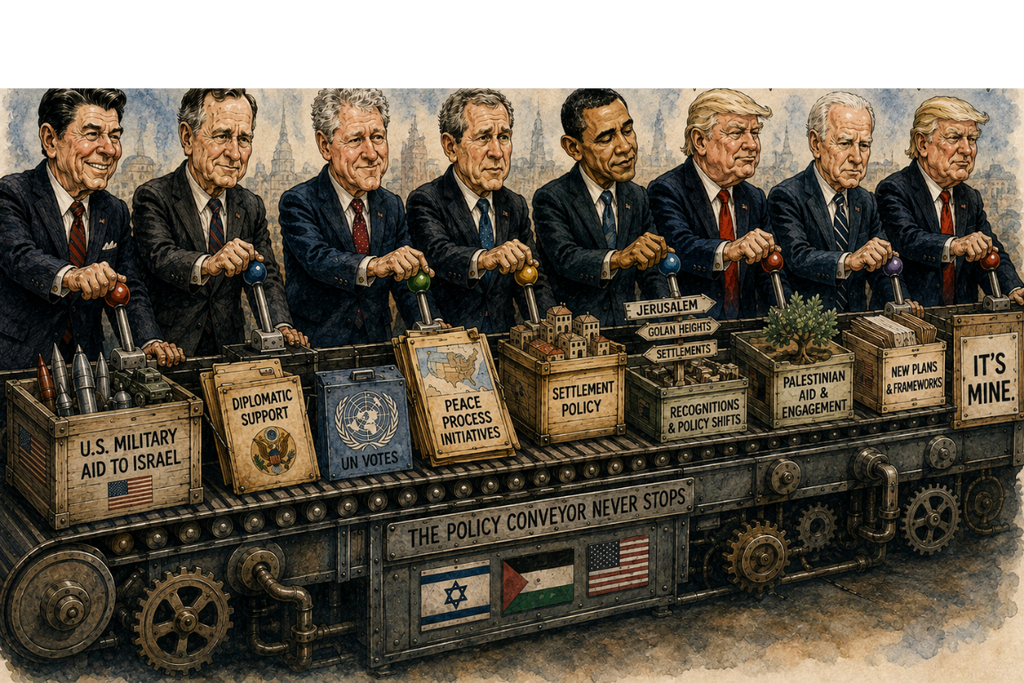
Nowhere is the difference between political change and structural continuity clearer.
Presidents have genuinely disagreed about Israel. George H. W. Bush confronted the Israeli government over settlements and briefly withheld loan guarantees. Clinton made Oslo central to American diplomacy. George W. Bush formally embraced Palestinian statehood. Obama fought Netanyahu over settlements and Iran and allowed Resolution 2334 to pass. Trump recognized Jerusalem and the Golan Heights and marginalized Palestinian diplomatic institutions. Biden restored Palestinian aid while keeping most of Trump’s changes. Trump returned and rewrote the equation again.
Those differences are real, and Palestinians and Israelis have lived their consequences.
But beneath them runs another history: military assistance, strategic cooperation, congressional support, intelligence sharing, regional security policy, domestic political constituencies, and decades of institutional commitments, much of it never submitted to a direct public vote.
That is why “Israel controls America” explains very little, and “America controls Israel” explains very little too.
This is an institutional alliance between two states with dramatically unequal power, deep strategic ties, powerful domestic constituencies, and decades of accumulated commitments.
Presidents can change the relationship, sometimes substantially.
They just do not begin from zero.
No president does.
About anything.
The Most Dangerous Stage Is Normalization
Looking at all of this together changed how I think about government power.
I used to focus primarily on the moment a power was created. Now I think the more important moment may come later.
First there is an emergency. Then comes an extraordinary response. Then controversy. Then somebody writes rules governing the extraordinary response. Another president uses it. Then another.
Eventually, we stop asking whether the government should possess the power at all and start asking whether we trust this particular president to use it.
That is a very different question, and it is a dangerous one.
Maybe I trust Barack Obama with a drone program. Maybe you trust Donald Trump with it. Maybe I trust Joe Biden with emergency authority. Maybe you trust Ronald Reagan.
Neither of us gets to choose every president who comes next.
That is the flaw in the bargain.
Democracy cannot depend on making sure the good guy always has the weapon. Eventually someone you do not trust gets the weapon.
The Parties Are Not the Same
I want to be absolutely clear about this.
Nothing I have written means Democrats and Republicans are interchangeable.
They aren’t.
Reagan and Clinton were different. Bush and Obama were different. Obama and Trump were profoundly different. Biden and Trump are different.
Policies changed because elections changed presidents. People gained rights and lost rights. Wars began and ended. Regulations were created and destroyed. Judges were appointed. Families were separated. Refugees were admitted and rejected. Palestinians received aid and lost aid.
Those differences are not theoretical.
They land on people.
So when someone tells me voting does not matter because “they’re all the same,” I reject that completely.
They are not all the same, and that is exactly why presidential power concerns me. If every president were interchangeable, it would not matter how powerful the office became.
The danger exists precisely because the people who occupy it are not interchangeable.
This Has Been Done Before
Here is the part of the argument I find most useful, and the part most often missing from essays like this one: clawing power back is not a fantasy.
It has happened, within living memory, in this country.
In the mid-1970s, after Watergate and after the Church Committee documented decades of illegal surveillance, assassination plots, and domestic spying by American intelligence agencies, Congress did something legislatures are supposedly incapable of doing.
It took power back from a presidency at the height of its reach.
Congress passed the War Powers Resolution. It passed the Budget and Impoundment Control Act, ending the president’s ability to simply refuse to spend appropriated money. It passed the Foreign Intelligence Surveillance Act, requiring warrants for national-security surveillance for the first time. It passed the Ethics in Government Act. It created permanent intelligence-oversight committees that still exist.
Not all of it worked.
The War Powers Resolution has been a dead letter for decades. Chadha gutted part of the framework. Later Congresses gave much of the power back.
But it happened.
A frightened, embarrassed, and genuinely bipartisan Congress decided the presidency had grown too powerful and did something about it.
That means structural reform is not fantasy.
It means Congress has to decide it actually wants to govern.
What Structural Reform Would Actually Look Like
If the problem is accumulated presidential power, the answer cannot simply be to elect better presidents. It has to include changing the office and changing the institutions that keep feeding it authority.
First, sunset the war authorizations. The 2001 AUMF should not function as a permanent blank check for conflicts generations removed from September 11. Major military action should require fresh congressional authorization rather than relying indefinitely on old statutes and increasingly creative executive interpretation. The War Powers Resolution also needs teeth Congress is actually willing to use, including funding cutoffs rather than deadlines everyone knows can be ignored.
Emergency powers need reform too. Congress should define emergencies more narrowly, require affirmative renewal at regular intervals, and repair the damage Chadha did, most plausibly by writing automatic expiration into the statutes themselves. Inaction should end an emergency rather than extend it. An emergency that can be declared with one signature should not require sixty-seven senators to end.
Congress also has to legislate on immigration. Presidents have spent decades filling legislative gaps with increasingly aggressive executive action in both directions. When Congress refuses to legislate, the presidency expands by default. That may temporarily benefit whichever party holds the White House, but it leaves the next president with the same authority.
Surveillance and national-security powers should carry meaningful expiration dates as well. Extraordinary authority should have to justify its continued existence rather than surviving simply because nobody has managed to dismantle it.
The pardon power deserves another look, particularly in cases involving a president’s own associates, administration, campaign, or personal interests. The constitutional power is broad, and real reform would be legally complicated. That is not a reason to pretend every use of it is institutionally harmless.
The professional civil service and the independence of law enforcement also matter. Presidents must be able to direct the lawful policy of the executive branch. That is part of what winning an election means. But there is a meaningful difference between democratic accountability and converting a professional civil service into a personal instrument.
The same goes for prosecutors.
A Justice Department capable of prosecuting corruption is essential. A Justice Department understood as the president’s personal prosecutorial arm is dangerous regardless of which party controls it.
And Congress itself may be the most important reform project of all.
A legislature that refuses difficult votes, avoids responsibility for war, delegates emergency authority, leaves immigration law broken, and then complains about presidential overreach is helping build the very presidency it claims to fear.
Congressional paralysis does not produce less government.
It produces more executive government.
None of this would eliminate executive power, and none of it should. Presidents need enough authority to respond to genuine emergencies, conduct diplomacy, administer the government, enforce the law, and defend the country.
The goal is not a powerless presidency.
The goal is a presidency that cannot accumulate extraordinary authority simply because every generation is too frightened, too partisan, or too politically comfortable to take any of it back.
My Grievance
So yes, I have grievances with every president since Reagan.
Reagan helped normalize an economic order that weakened labor and elevated market power, and he failed for years to meet the AIDS crisis with adequate presidential urgency. George H. W. Bush institutionalized parts of the punitive state and demonstrated the reach of American military and pardon power. Clinton made portions of Reaganism bipartisan, expanded punitive criminal justice, embraced deregulation, went to war without Congress, and failed, with the rest of the world, to respond adequately to genocide in Rwanda.
George W. Bush built much of the modern War on Terror machinery, invaded Iraq on flawed intelligence, and left his successors extraordinary surveillance, detention, and military powers. Obama dismantled some of that machinery, reformed some of it, and normalized some of it by continuing to use it. Trump inherited the machine and showed what a president willing to push institutional boundaries could do with it. Biden restored many norms without dismantling much of the underlying structure, and Gaza demonstrated the limits of presidential criticism when structural commitments go untouched. Trump returned to an office more powerful than the one he entered in 2017 and, thanks in part to judges he appointed, more legally insulated too.
But my largest grievance is with none of them individually.
It is with us.
With Congresses that surrender authority when frightened. With courts that expand presidential power without adequately considering who might wield it next. With parties that object to executive power when the other side holds it and rediscover its usefulness the moment their own president takes office. With voters, including me, who cheer presidential power when it produces the outcome we wanted. With a political culture that increasingly treats the president as some combination of king, national father, commander, prosecutor, economist, legislator, and savior.
We built this slowly, usually for understandable reasons, one emergency at a time, one statute at a time, one precedent at a time, and one president at a time.
That may be the most important thing I took from looking back at every president of my lifetime.
The question is not simply whether I trust the person sitting in the Oval Office today. The question is whether I am comfortable handing that same power to the person I fear most.
Because eventually that person wins an election. Eventually that person inherits the statute. Eventually that person appoints the officials. Eventually that person declares the emergency. Eventually that person gets the keys.
And if the survival of American democracy depends on making sure the right person always gets them, then we have already built the wrong kind of presidency.