
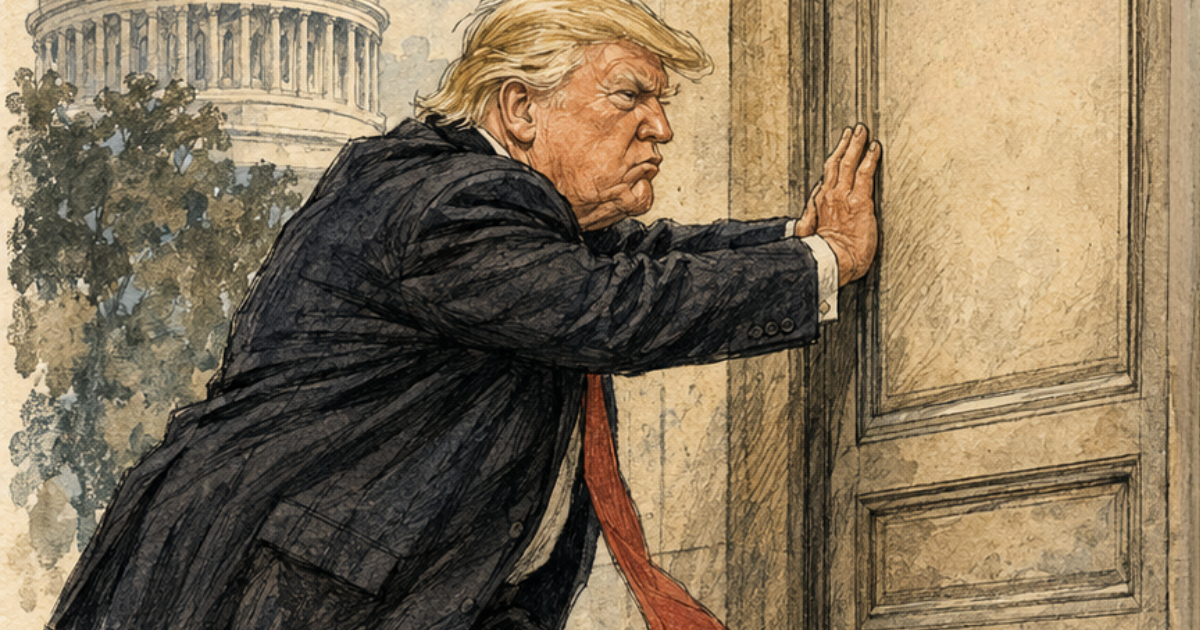
The things Trump has tried to do, the people and institutions that stopped him, and why giving up is exactly the wrong thing for us to do.
I keep hearing some version of the same argument: What is the point? The president is just going to do whatever he wants anyway. Courts will not matter. Congress will not matter. Protests will not matter. Voting will not matter. He will sign an executive order, ignore everyone who objects, and do it anyway.
There is an understandable reason people feel that way. The presidency is enormously powerful, Donald Trump has pushed aggressively at the boundaries of presidential authority during his second term, and some of those efforts have succeeded. Congress has not consistently acted as a meaningful counterweight, and the Supreme Court has allowed a number of administration policies to proceed. There have also been serious disputes over compliance with judicial orders. Pretending that America’s system of checks and balances is functioning perfectly would be as misleading as saying those checks no longer exist.
But there is an enormous difference between saying that the president has a great deal of power and saying that the president can do whatever he wants. The record since January 2025 demonstrates that difference rather dramatically. During Trump’s first 100 days back in office, more than 200 lawsuits challenged administration actions and more than 70 judicial rulings blocked or delayed portions of his agenda. Some of those decisions were eventually overturned. Others survived. Some policies were narrowed. Some were abandoned. Some battles are still underway.
That messy record is actually the point. A president does not issue an order and automatically make it permanent law. Presidential power exists inside a system containing Congress, courts, states, laws previously enacted by Congress, constitutional rights, appropriations rules, administrative procedures, elections and institutions capable of challenging government action. The effectiveness of those checks depends heavily on whether anyone actually uses them.
A Signature Does Not Create Unlimited Power
The Constitution does not make the president the government. Article I gives legislative power to Congress. Congress has the power to tax, appropriate money, regulate interstate and foreign commerce, establish lower federal courts and enact laws necessary to carry out federal powers. Article II gives executive power to the president and directs the president to faithfully execute the laws. Even the president’s treaty and appointment powers frequently require Senate participation.
That distinction matters because an executive order is not magic. A president can direct the executive branch within the president’s lawful authority, but signing a piece of paper does not give the president a power that the Constitution or Congress has withheld.
Trump’s attempt to restrict birthright citizenship provides one of the clearest examples. On his first day back in office, Trump ordered federal agencies not to recognize citizenship for certain children born in the United States. Lawsuits followed immediately. Lower courts blocked the order, and in 2025 the administration won an important Supreme Court battle limiting the ability of individual federal judges to issue universal injunctions. That was widely described as a major victory for Trump, but the Supreme Court had not yet decided whether his birthright-citizenship policy itself was constitutional.
The litigation continued. On June 30, 2026, the Supreme Court decided the underlying citizenship question and rejected Trump’s attempt to restrict birthright citizenship. The Court held that the children covered by the order were citizens under the Citizenship Clause of the Fourteenth Amendment.
That sequence is worth remembering. Opponents lost an important round in 2025. They did not therefore conclude that the president could do whatever he wanted. They continued using the legal avenues available to them, and the underlying policy eventually failed before the Supreme Court.
Congress Gives Presidents Power, Too
Another major example involves Trump’s tariffs. The Constitution gives Congress the power to impose duties and regulate commerce with foreign nations. Congress has delegated considerable trade authority to presidents through various statutes, which is one reason presidents can exercise substantial control over trade policy. But delegated power still has limits.
Trump attempted to impose sweeping tariffs using the International Emergency Economic Powers Act, or IEEPA. Businesses challenged that authority in court. In February 2026, the Supreme Court held that IEEPA did not authorize the president to impose those tariffs. The Court was not deciding whether tariffs themselves were wise or unwise. It was answering a more basic constitutional and statutory question: Had Congress actually given the president this particular power through this particular law? The answer was no.
That did not leave the president powerless over trade. Other laws delegate significant tariff authority to the executive branch, and the administration turned to those authorities instead. That is what makes the case so useful for understanding checks and balances. The result was not, “Trump cannot impose tariffs.” It was, “The president has to exercise authority that the law actually gives him.”
That is a constraint on presidential power.
The President Does Not Control Congress’s Wallet
Money provides another important example. Congress possesses the constitutional power of the purse. The Constitution states that money cannot be drawn from the Treasury except through appropriations made by law. Presidents administer programs and spending, but they do not simply inherit Congress’s appropriations power when they take office.
The Government Accountability Office, the nonpartisan congressional watchdog, has repeatedly examined whether the Trump administration unlawfully withheld congressionally appropriated funds. GAO concluded that the Department of Health and Human Services violated the Impoundment Control Act when it withheld NIH funding in 2025. GAO also found violations involving Head Start funding and some FEMA appropriations, although it found no violation in other cases.
That last part matters. The system is not supposed to produce the answer “the president loses” every time someone objects to presidential action. The question is whether the executive branch is acting within the authority the law provides. Sometimes the answer is yes. Sometimes it is no.
Institutions Can Say No
Some of the most revealing examples have come from institutions that had a choice between accommodating presidential pressure and fighting it.
In 2025, Trump issued executive orders targeting several major law firms over their previous legal work, political associations and diversity policies. The orders sought, among other things, to restrict access to federal facilities and affect government contracts involving the firms’ clients. Some large firms negotiated agreements with the White House.
Four firms chose another route. Perkins Coie, Jenner & Block, WilmerHale and Susman Godfrey sued.
Four federal judges struck down the orders, finding constitutional violations including infringements of First Amendment rights. The administration appealed. Then, in March 2026, the Justice Department dropped those appeals. The lower-court rulings therefore remained standing.
That story is important because the difference was not simply that “the courts saved them.” Someone had to challenge the government in the first place. Lawyers had to file cases. Organizations had to be willing to withstand pressure. Judges had to exercise judicial authority. The administration then had to decide whether to continue defending the orders.
Checks and balances are not self-executing. They work only when people and institutions use the powers the law gives them.
States Have Power, Too
The federal government is powerful, but it is not the only government in the United States. States retain their own governments, officials and legal authority, and state attorneys general have become major participants in litigation over presidential power.
That can be seen in current litigation over Trump’s attempt to dismantle several small federal agencies. Twenty-one state attorneys general challenged the administration’s efforts involving the Minority Business Development Agency, Federal Mediation and Conciliation Service and U.S. Interagency Council on Homelessness. A lower court blocked the administration’s actions. As of September 2026, the case remains under consideration by the First Circuit, where judges have questioned whether the executive branch can effectively eliminate agencies that Congress created simply by removing their staffs and stopping their work.
We do not yet know the final outcome. That means this example should not be counted as a permanent defeat for Trump. It demonstrates something else: a presidential directive can immediately encounter another governmental institution with both the ability and willingness to challenge whether the president possesses the claimed authority.
Sometimes Resistance Changes the Policy Before the Final Ruling
Court cases are not always simple stories with a winner and a loser. Litigation can delay implementation, force the government to defend its legal reasoning, expose internal decisions, narrow a policy or cause an administration to change course before a final judgment arrives. That is why merely counting court victories can be misleading. The better question is whether resistance changes what government is able to do, how quickly it can do it, or the legal conditions under which it can proceed.
Harvard, for example, challenged the administration’s termination of roughly $2.2 billion in federal research grants. A federal judge ruled in Harvard’s favor in 2025 and barred the administration from continuing to terminate research funding on the challenged grounds. The government appealed, meaning the dispute was not finally resolved by that district-court victory.
The distinction matters. “A judge blocked it” does not necessarily mean “this policy is dead forever.” An injunction can be stayed. An appellate court can reverse a lower court. The Supreme Court can intervene. The government can rewrite a policy and try again under different authority.
But temporary does not mean meaningless. Delay itself can matter. Narrowing a policy can matter. Requiring the government to follow a statutory process can matter. Keeping billions of dollars flowing while litigation continues can matter. Giving people time to organize, appeal or prepare can matter.
Sometimes the President Wins
This part cannot be left out.
The Trump administration has won significant legal battles during its second term. Courts have declined to block some immigration enforcement actions, federal workforce changes and other policies. The Supreme Court has sometimes stayed lower-court orders that had restricted the administration. Some policies that initially appeared to have been stopped were later permitted to proceed.
That does not prove that resistance is pointless. It proves that resistance is a mechanism, not a guarantee.
Courts are not supposed to exist to defeat presidents. Congress is not constitutionally required to oppose a president simply because members of the public do. States do not automatically prevail when they sue the federal government. Protest does not create a veto. Public comments do not automatically change regulations. Elections do not guarantee that any particular policy will disappear.
These mechanisms provide ways to contest power. Outcomes depend on the Constitution, statutes, evidence, standing, procedure, judges, legislators, elections, institutional decisions and, frequently, persistence.
We Are Watching This Happen Right Now
The fight over mail voting in the 2026 midterms provides an unusually immediate example.
Trump sought major changes involving mail ballots and the Postal Service. New Postal Service regulations would have required states to submit information through a federal system and obtain approval for ballot-envelope designs. States, organizations and others challenged the changes. Federal judges blocked implementation, including Judge Carl Nichols, whom Trump himself appointed.
The administration went to the Supreme Court. In September, the Court declined to allow the restrictions to take effect for this year’s midterm elections. The Postal Service then stopped work on the computer system intended to implement the new requirements and told employees that the new rules would not be enforced in the 2026 federal election.
Whatever one thinks about mail voting as a policy matter, this is precisely what the claim “the president just does whatever he wants” fails to explain.
The president wanted something. The executive branch attempted to implement it. Other people and institutions challenged the action. Courts exercised their authority. The administration sought review from a higher court. The Supreme Court did not give the administration the relief it requested for this election. The Postal Service stopped implementation. Presidential preference did not automatically become reality.
So What Can Anyone Actually Do?
This is where discussions of checks and balances too often become vague. People are told to “get involved,” “call Congress,” “vote” or “protest,” as though all forms of participation accomplish the same thing. They do not. Different kinds of power require different kinds of resistance.
When a president attempts to spend money Congress never authorized, or refuses to spend money Congress legally appropriated, congressional oversight, appropriations law, GAO review and litigation can become relevant. When an executive order allegedly exceeds statutory or constitutional authority, people or institutions with legal standing can challenge it in court. When federal action intrudes on state authority, states can litigate. When an agency adopts a rule without following required procedures, affected parties can challenge that rule under administrative law.
When Congress has delegated broad authority to the executive branch, Congress can change the underlying statute. When lawmakers refuse to exercise congressional powers, elections determine who occupies those seats. When universities, businesses, law firms, nonprofits or other institutions face federal pressure, their leaders can decide whether to comply, negotiate or challenge the government. When government actions remain hidden, journalists, whistleblowers, inspectors general, watchdog organizations and public-records litigation can bring information into public view.
And public pressure can operate through all of those channels. Protest can affect political incentives. Constituent pressure can affect legislators. Organizing can provide plaintiffs, lawyers, money and public attention for litigation. Journalism can provide information that leads to congressional inquiries or lawsuits. Public comments can become part of administrative proceedings. Elections determine who holds many of the offices that possess these powers in the first place. None of those things guarantees victory. They are tools, not magic spells.
What Happens When We Decide Nothing Matters?
This is the part of the argument that worries me most.
If people become convinced that presidential power is unlimited, they can begin behaving as though it is. Members of Congress can stop defending congressional authority. Institutions can comply with demands they could legally challenge. State governments can decline to contest federal actions. Organizations can decide litigation is not worth the trouble. Journalists can stop investigating. Citizens can stop organizing, commenting, protesting or voting because they assume the result has already been decided.
At that point, powers that still exist on paper become weaker in practice because nobody is using them.
The Constitution gives Congress legislative powers and control over appropriations. Congress possesses investigative and oversight authority connected to its legislative responsibilities. The House can impeach federal officials, and the Senate can conduct impeachment trials. Courts can decide cases challenging executive action. States possess their own governmental powers. Elections determine who occupies Congress, state governments and the presidency.
None of those institutions is guaranteed to use its power wisely, aggressively or in the way any particular citizen wants. That is the uncomfortable reality of constitutional government. Checks and balances are not an invisible force field surrounding democracy. They are authorities assigned to actual institutions occupied by actual human beings.
That means the better question is not, “Will the system stop him?” There is no single “system” that wakes up in the morning and decides to defend itself. There are judges deciding cases, members of Congress deciding whether to assert congressional authority, state officials deciding whether to sue, lawyers deciding whether to bring cases, organizations deciding whether to resist, journalists deciding whether to investigate, civil servants deciding whether to report wrongdoing, and citizens deciding whether any of those people will hear from them.
The record of Trump’s second term does not tell us that every attempt to expand presidential power will be stopped. Clearly, that is not true. It does not tell us that every court will rule against him, that Congress will suddenly become an aggressive check on executive authority, or that every protest will produce a policy reversal.
It tells us something simpler and more important. The president cannot just do whatever he wants.
Trump has attempted things that courts have blocked. He has asserted powers the Supreme Court concluded Congress never gave him. His administration has withheld money that GAO concluded the law required it to make available. Institutions have challenged his orders and won. States have forced executive actions into court. Policies have been delayed, narrowed, rewritten and abandoned. Other policies have survived every challenge and gone forward.
That is what a struggle over governmental power actually looks like.
So when someone says, “There is no point. He will just do whatever he wants anyway,” the answer is not that American institutions will inevitably save us. History gives us no basis for that kind of complacency. The answer is that presidential power has limits, but limits matter only when someone is willing to enforce them.